How did Lautrec get its pink garlic?
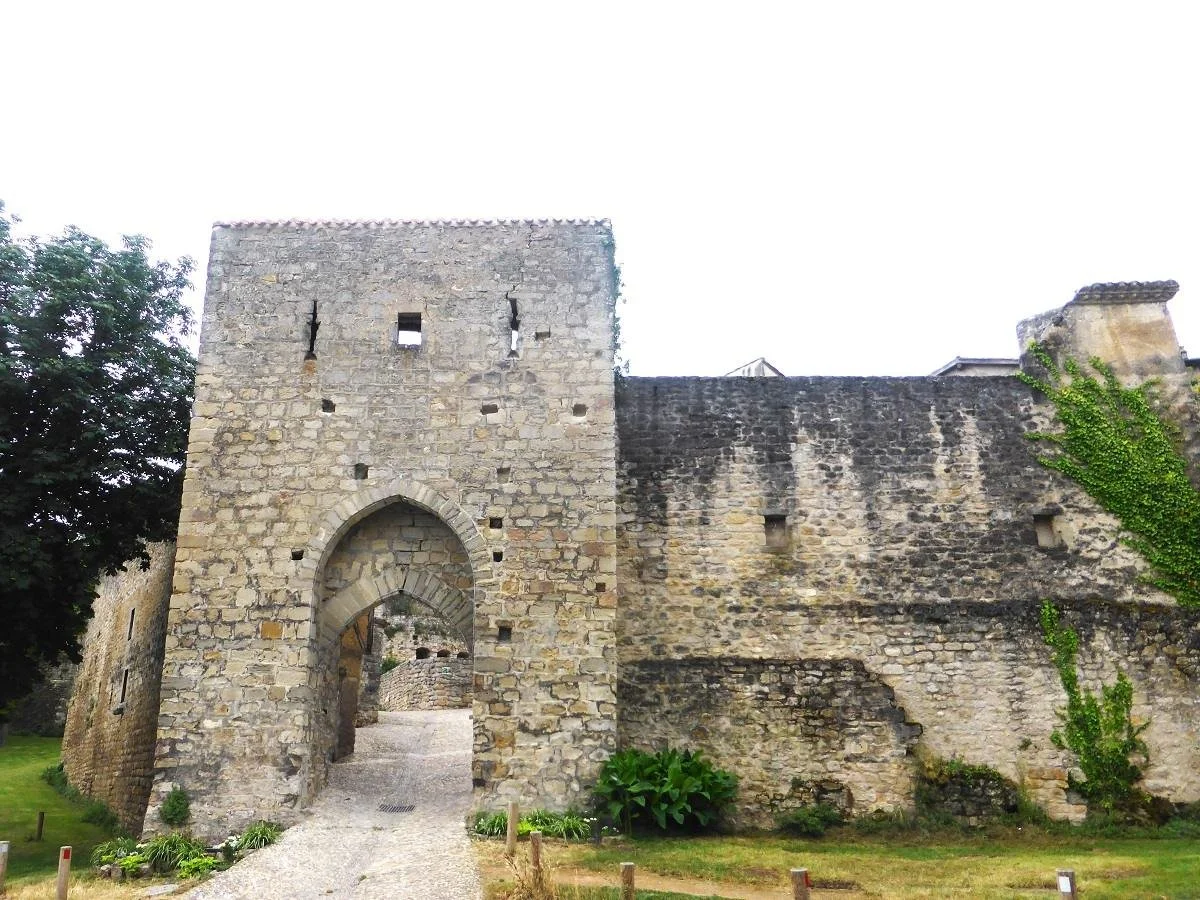
Porte de la Caussade, Lautrec
Garlic charter
Around 940 CE, Lautrec was important enough to have its first viscount, a man called Sicard. In 1291, one of his descendants, Bernard de Lautrec, signed a charter which mentions a tithe tax on garlic in the neighbouring town of Graulhet. This ancient parchment fails to specify if the tax was identical for pink garlic and more common varieties, but it does at least provide firm evidence that garlic has enjoyed a long association with this area.
The legend of the pink bulbs
Exactly when pink garlic took root in Lautrec is unknown, and its miraculous appearance is, perhaps inevitably, the subject of a legend. In the Middle Ages, a travelling merchant stopped for refreshment at an inn on the southern edge of town called La Oustalarié. Perhaps he should have checked his pockets before he ordered, because when he came to pay his bill, he was short of money. Instead, he offered the innkeeper a few bulbs of pink garlic. The innkeeper accepted this unusual form of payment, no doubt intrigued by the pink tint of the bulbs. Presumably he liked the taste too, and he planted a couple of cloves so that he could enjoy the same pink colour and delicate taste the following year. And the rest is history, or so the legend would have us believe.
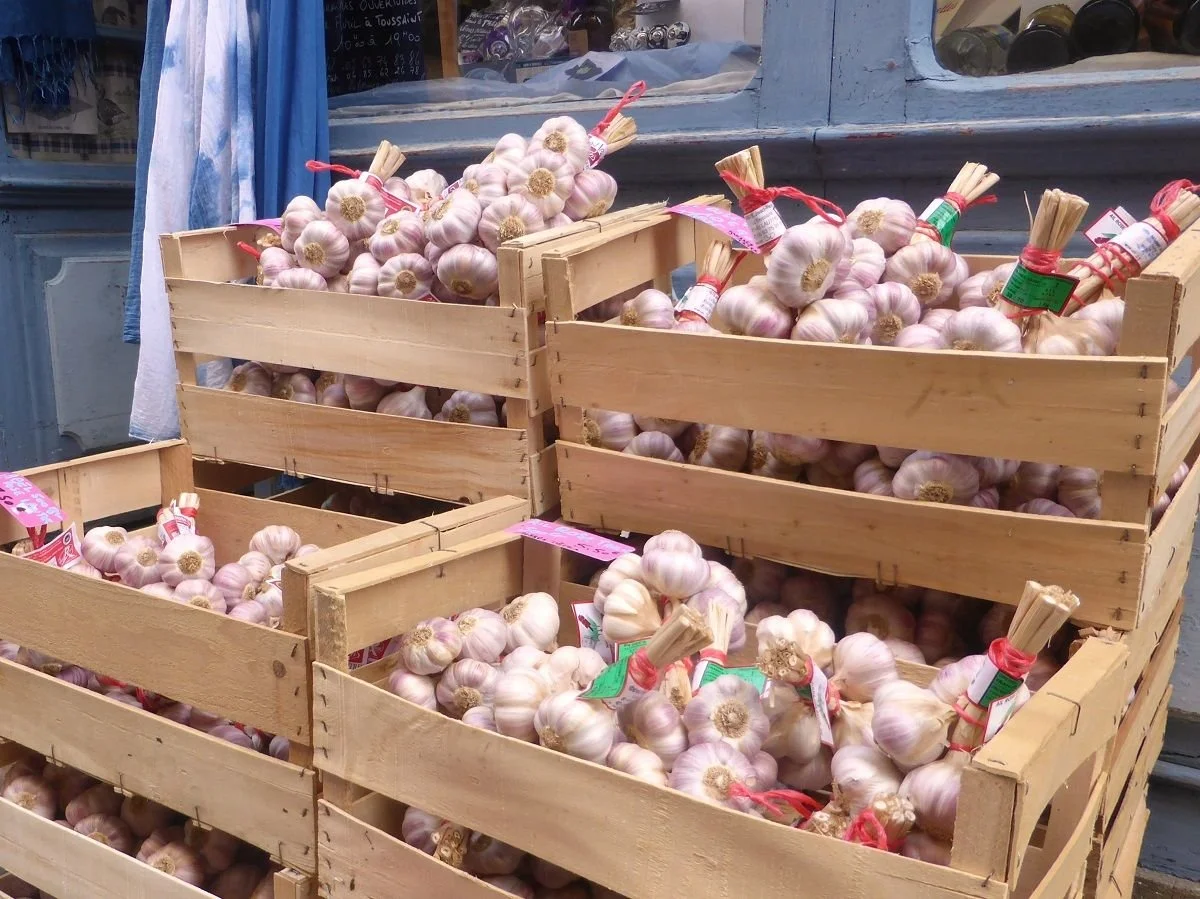
Pink garlic of Lautrec
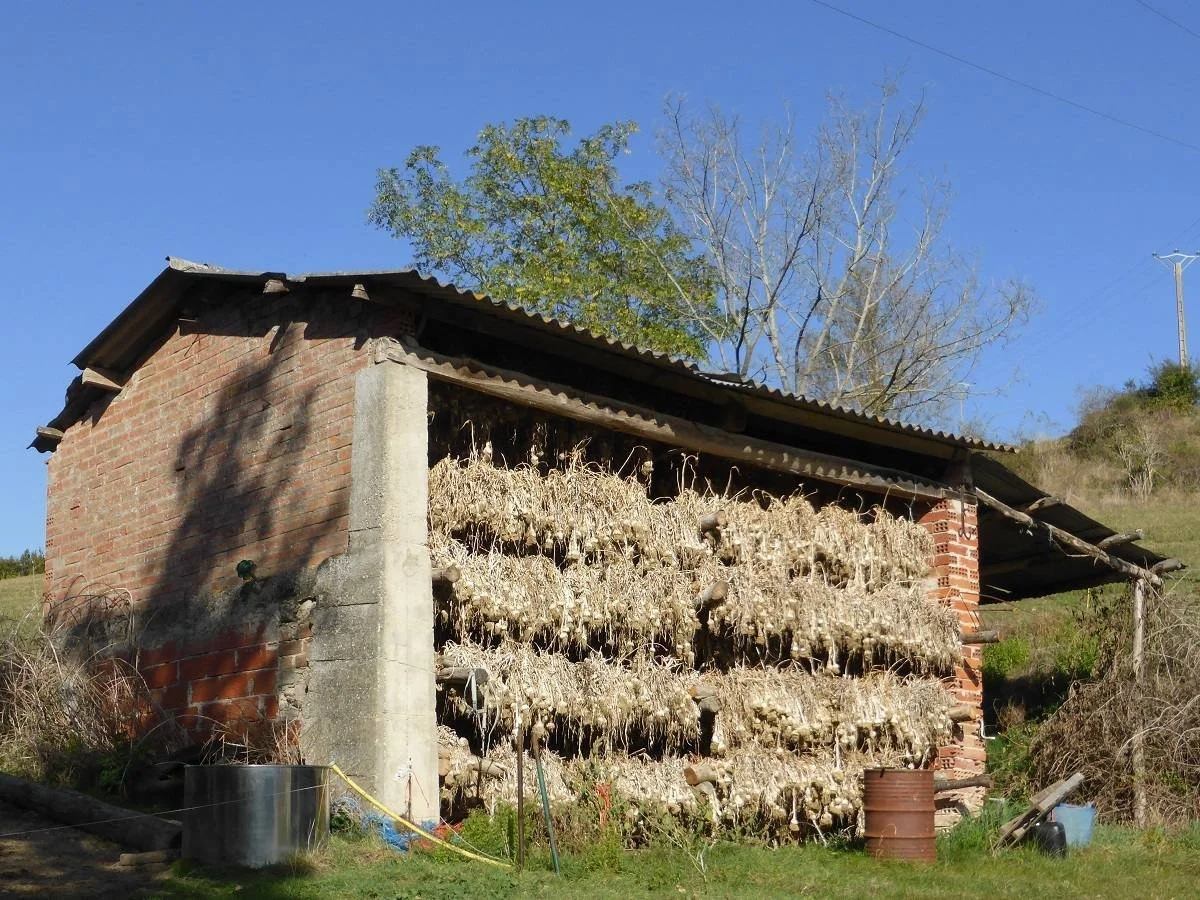
Garlic drying shed near Lautrec
French and European quality awards
By the 19th century, cultivation of pink garlic had become widespread on small parcels of land all around Lautrec, but it was only sold in the immediate locality. In 1959, the Syndicat de Défense du Label Rouge Ail Rose de Lautrec was set up by a bunch of young farmers who were so passionate about their pink garlic, they were determined to protect its name and gain wider recognition of its outstanding quality. It took them until 1966 to gain their first badge, a French award called Label Rouge. When the European Union set up its PDO and PGI schemes in 1992, they set out to win one of those labels too, and they succeeded four years later.
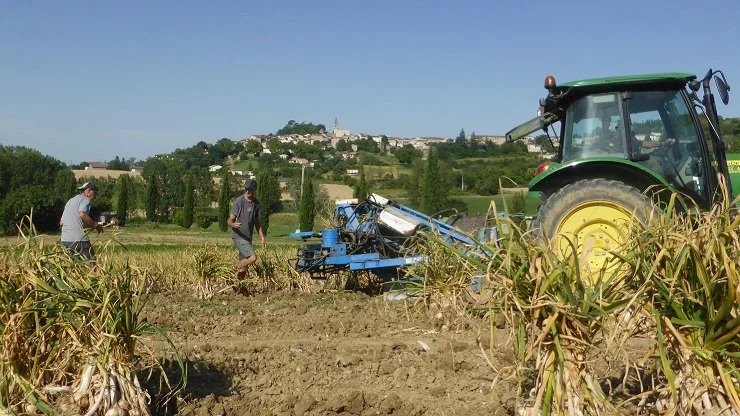
Harvesting pink garlic, with Lautrec in the background.

Enjoying a bowl of pink garlic soup at the Lautrec garlic festival
A harvest and a festival
If you travel through the countryside around Lautrec in June and July, you can’t miss the pungent smell of garlic. When the harvest is in full swing, even garlic lovers may be overwhelmed by the odours. And then, at the beginning of August, Lautrec holds its annual garlic festival. Each day, visitors are offered a small share of the 2,000 litres of garlic soup that simmer away beneath the shady arcades surrounding the central square. Fortunately, other local food and drink producers offer a range of alternatives.
