Equal opportunities on the Canal du Midi in 1669

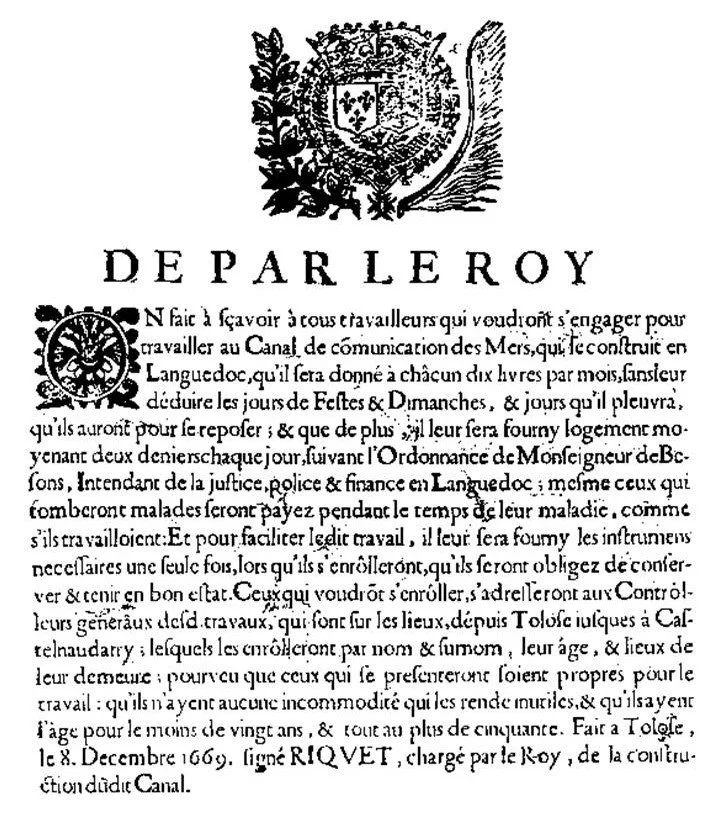
On this day in 1669, the man who was building the Canal du Midi published a job advert making this unprecedented offer to any man or woman between the ages of 20 and 50 who was fit for work: ‘In the name of the king we wish to make it known to all labourers who would like to sign up to work on the canal…that each person will be given ten livres a month without any deductions for public holidays or Sundays, or rainy days which will be had as rest days, and in addition he will be provided with a lodging for an average of two pennies a day…even those who fall ill will be paid during their illness as if they were working.’
Pierre-Paul Riquet: a man ahead of his time
Sick pay, holiday pay, monthly pay, equal pay. These were revolutionary concepts in 1669, and the last one remains more of an aspiration than a reality even today. So why did Pierre-Paul Riquet make such a generous offer which was undoubtedly ahead of its time?
Giant construction projects
Starting in 1667, Riquet managed an extraordinary number of construction sites. Within five years, his navvies had dug 120 kilometres of the main canal from Toulouse to Trèbes and had even started work on the next section linking Trèbes to the sea. In the Montagne Noire, his labourers had dug over 60 kilometres of supply channel to bring water from the mountain to the highest point of his canal, and the largest dam in the world (Saint-Ferréol) was sufficiently advanced to start preparing for its first wet tests.
As many as 12,000 workers
To achieve so much so quickly, he employed platoons of stonemasons, carpenters and blacksmiths, and an army of navvies. His workforce reportedly peaked at 12,000 – although 6,000 is probably a more accurate estimate – and the bulk of it was made up of peasants from the surrounding countryside. A significant proportion were women – perhaps as much as a third – and Riquet even expressed a preference for female workers in a letter he wrote to Louis XIV’s finance minister in 1669: ‘All the women who come to me, I shall hire them in the knowledge that these women working under contract will do as much work as men who are paid by the day.’