Oppidum d’Ensérune – a story of discovery with an equine twist
ARCHAEOLOGY ON THE HOOF
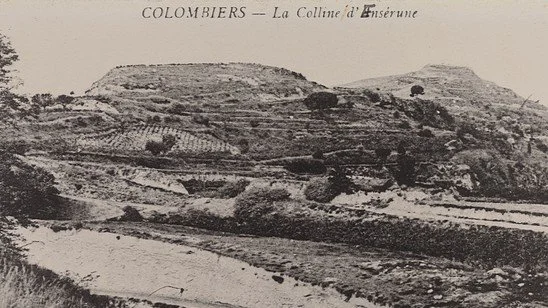
The hill of Ensérune in 1949 (Licence Ouverte/Open Licence)
Ensérune is a hill just to the south of Béziers, and it overlooks the extraordinary field system of Montady. [READ MORE HERE] One day in the spring of 1895, Félix Mouret rode his horse to the top. Twenty years had passed since phylloxera had destroyed the vineyards, and most of the hill had reverted to scrubland. In several places, the ground beneath his horse’s hooves sounded hollow.
Félix Mouret had studied law in Montpellier, but he was also passionate about archaeology. He dismounted and inspected the ground more closely. In several areas, the winter rains had created depressions like funnels in the ground. He suspected that these, and the places where the ground had sounded hollow, might be the locations of ancient storage silos and cisterns. [SILOS AND FOOD SECURITY] This hilltop, he wrote afterwards, would be of great interest to explore further.
THE MOST IMPORTANT COLLECTION OF CELTIC OBJECTS IN THE SOUTH OF FRANCE
Exactly twenty years later, Félix Mouret bought the land where he had detected the silos. He began digging, but his most significant finds had nothing to do with food storage. Instead, he unearthed more than 300 tombs containing a trove of funerary objects. This is the most important collection of Celtic-period goods ever found in the south of France, a mixture of Celtic arms and armour, and Greek, Iberian and Etruscan vases.
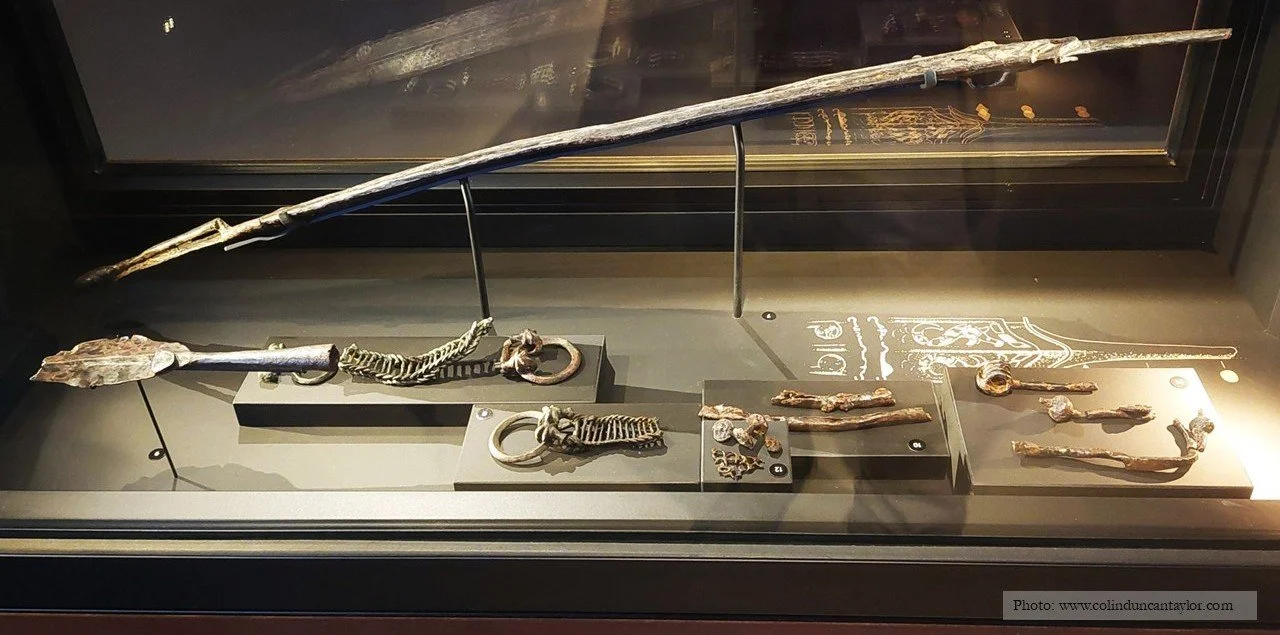
Grave 163 contained arms and armour from a Celtic warrior, including a sword and its iron sheath, a bronze belt chain, a spearhead and a shield.
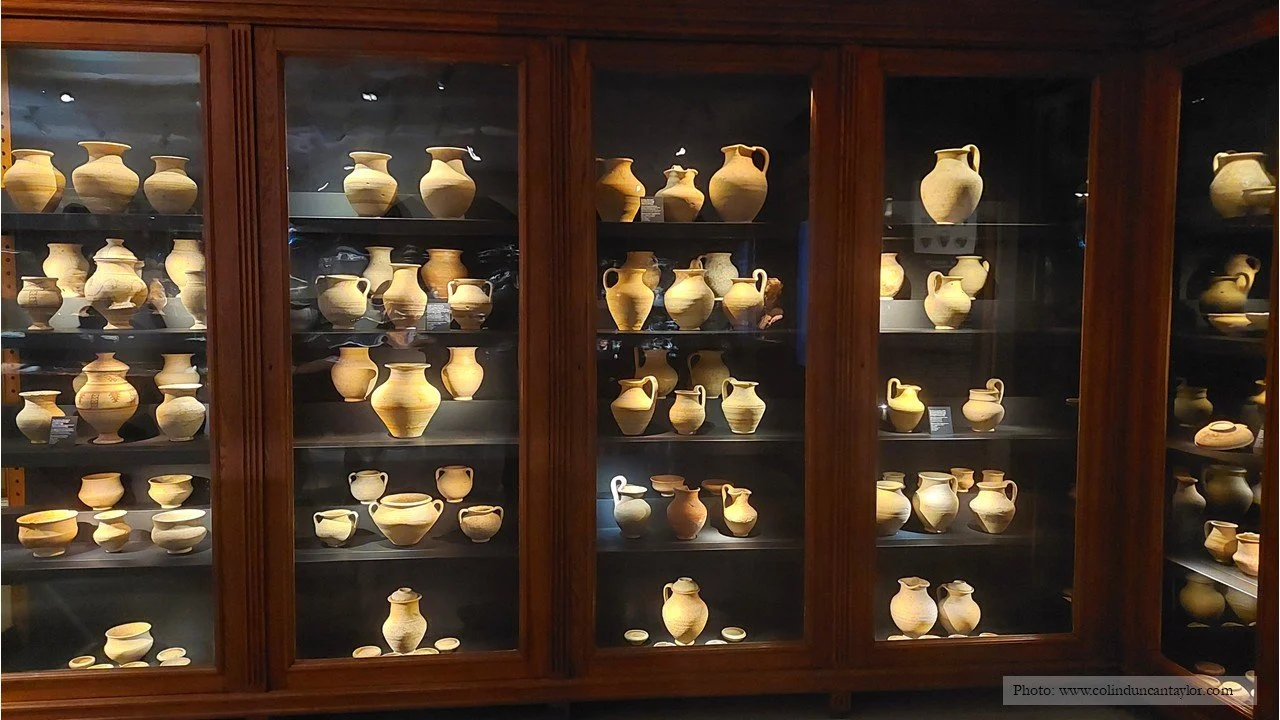
A small part of the collection of vases discovered at Ensérune!
Félix Mouret was unable to explore the entire hilltop because, in 1911, a jeweller from Béziers called Joseph Maux had bought a plot of land at its highest point. By the time Félix began his excavations in 1915, the jeweller had completed the construction of a grand Tuscan-style home which he named after himself: the Villa Maux.
ENSÉRUNE BECOMES A NATIONAL MONUMENT
Such was the importance of the discoveries made by Félix Mouret, the French government bought the Villa Maux and 22 hectares of the hill in 1922. Since then, a procession of archaeologists have explored more and more of the hill and its slopes during successive seasons of excavations which continue to this day. The Villa Maux was transformed into a museum in 1934, and its galleries have exhibited the treasures of Ensérune ever since. They have been modernised several times over the years, most recently from 2019-22.
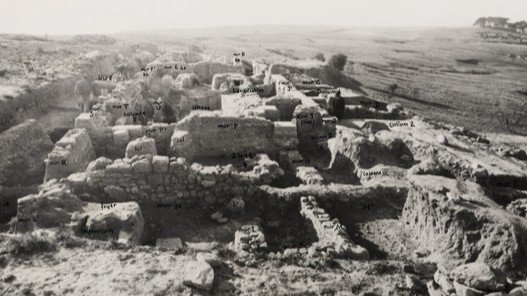
Excavations at Ensérune in 1947 (Licence Ouverte/Open Licence).
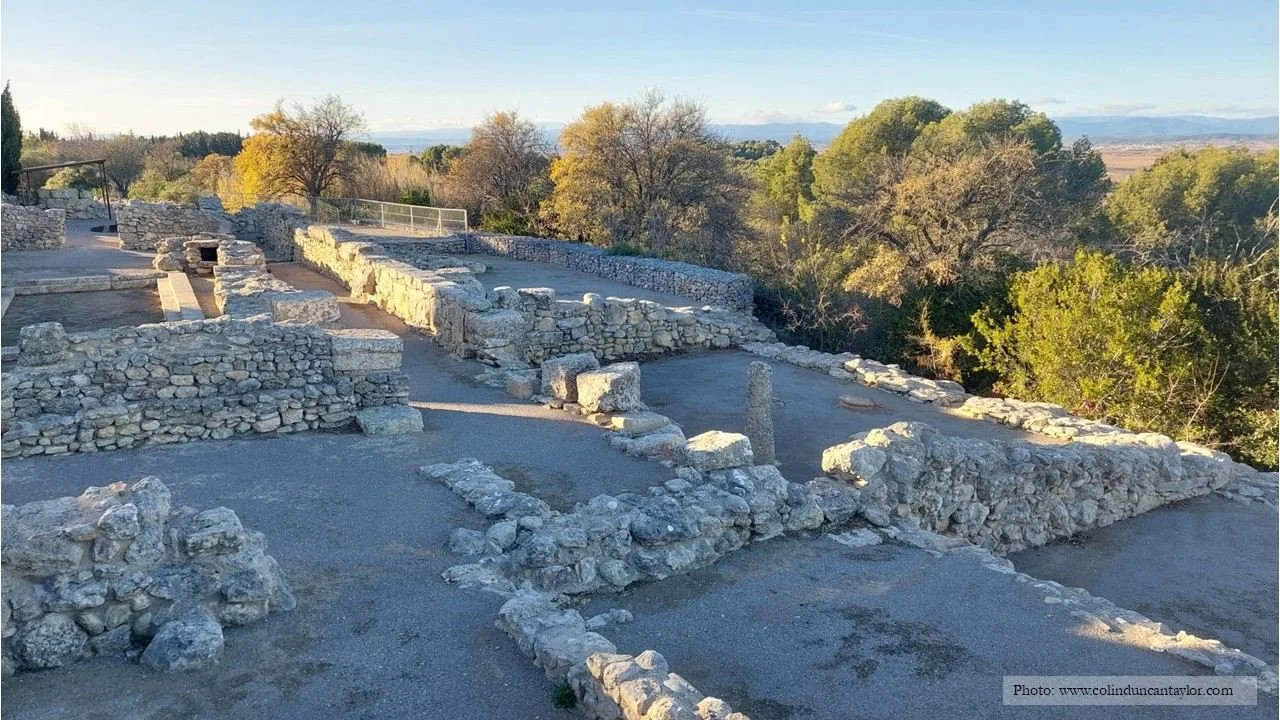
More recent excavations at the north-western end of the hill.
THE MOST IMPORTANT OPPIDUM IN THE SOUTH OF FRANCE
Today, Ensérune is the best example of an oppidum in the south of France. The Romans used this word to describe a fortified settlement on a hill, particularly in Gaul. In Latin, Ensérune was Anseduna, but it was occupied long before the Romans arrived: the oldest part of the settlement dates back to around 575 BCE, and it was founded by a Celtic people called the Elisyces.
The strategic attractions of this location are easy to comprehend. Steep slopes made the hill easy to defend, and from its large, flat top, the Elisyces enjoyed commanding views of the surrounding countryside from the Massif Central to the Pyrenees via the Mediterranean coast. Ensérune was also ideally placed for trade, and the inhabitants soon established trading links with Greek colonies in Massalia (Marseille), Agatha (Agde) and Emporion (Empúries in Catalan or Ampurias in Spanish).
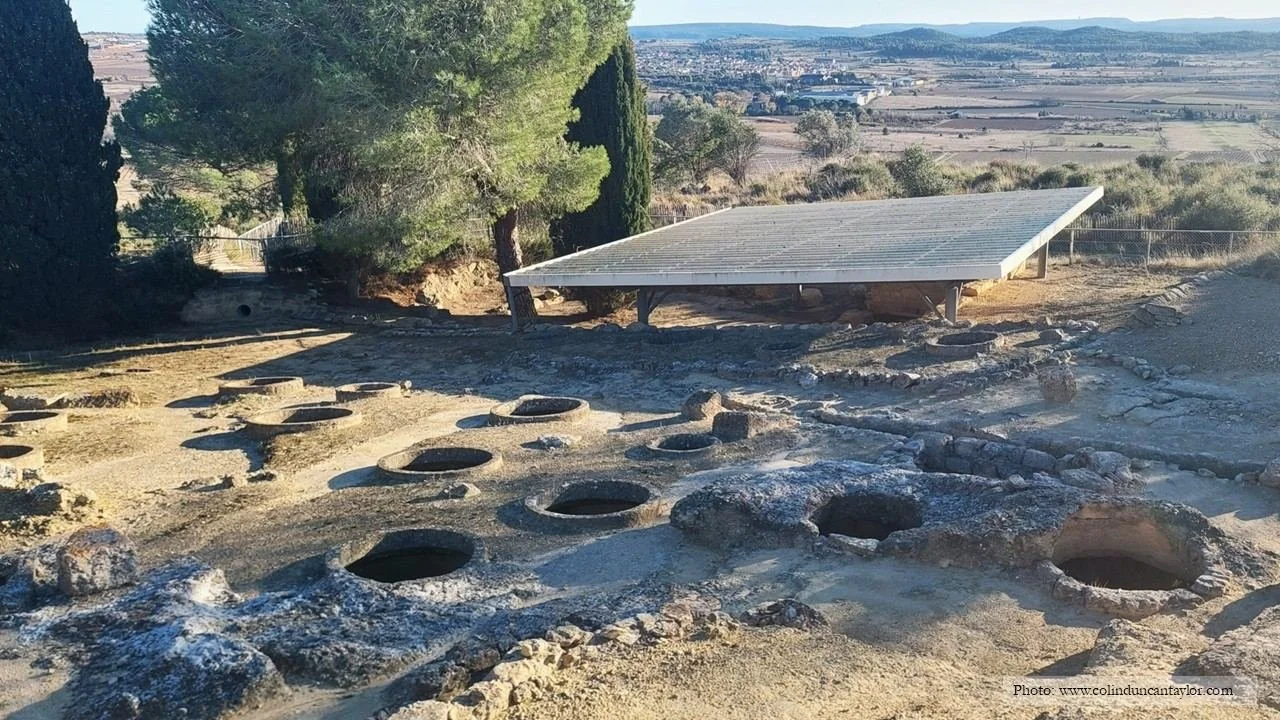
Seventy-two storage silos have been found on Silo Terrace.
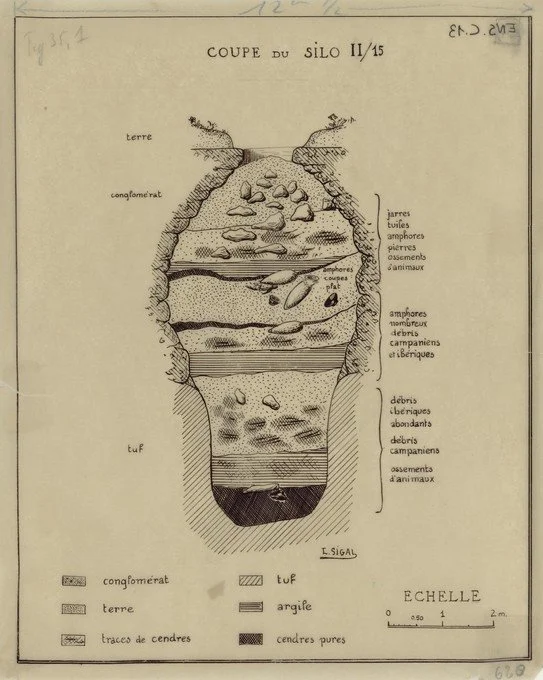
Cross section of one of the silos (Licence Ouverte/Open Licence).
As well as trade, members of this community made bronze objects using copper from the Hérault and tin from the Massif Central. They also cultivated crops, raised livestock and fished in the surrounding lakes. They must at times have enjoyed abundant harvests because Félix Mouret and subsequent archaeologists have discovered a total of around 300 silos, 72 of them in one small area known today as Silo Terrace.
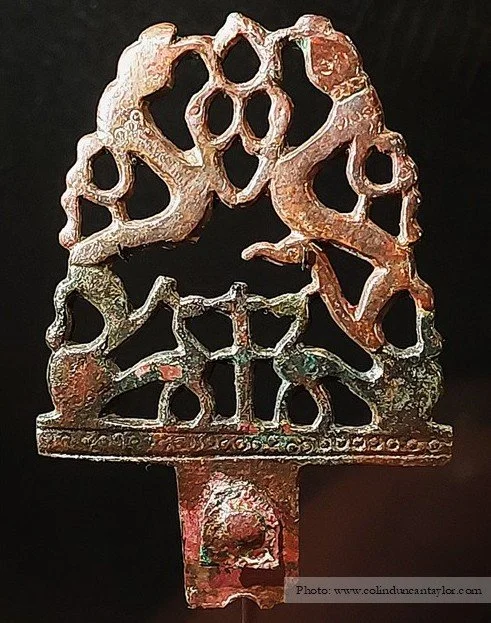
A belt clasp discovered in grave IB71.
RICH IN EPIGRAPHS
Until around 200 BCE, Ensérune’s closest cultural links were with Iberian tribes on the other side of the Pyrenees. These peoples could read and write, but we know little about their language apart from simple inscriptions on ceramic objects, mainly of people’s names. Ensérune has bequeathed us 1,000 epigraphs of this type, the largest collection found anywhere.
From around 200 BCE, the young Roman republic played an increasingly important role around the Western end of the Mediterranean. In 118 BCE, the Romans founded the colony of Narbo Martius (Narbonne), 16 kilometres to the south of Ensérene. That same year, they also began building the Via Domitia which would eventually stretch all the way around the coast from Italy to the Pyrenees, and pass within a few hundred metres of Ensérune. Inevitably, the Celtic oppidum with its distinctive culture was absorbed by the Roman world.
The final photograph in this article shows a belt clasp discovered in grave IB71. It is an intricate piece of work, and the whole design or its individual elements can be interpreted in a variety of ways: a tree; a pair of birds facing each other; two animals facing each other; a human figure with antlers on its head grabbing the necks of two animals facing each other; two fantasy animals. Don’t worry if you cannot see all these things: a graphic in the museum illustrates each interpretation with colour-coded diagrams.
SPECIAL EXHIBITION UNTIL 8 NOVEMBER 2026
If you are considering a visit, try to come before 8 November 2026. The temporary exhibition ‘Les Pionniers’ (or ‘The Pioneers’) is a well-executed, multi-media experience which recreates this 20th-century story of archaeological discovery.
