Devil’s bridges of the Pyrenees
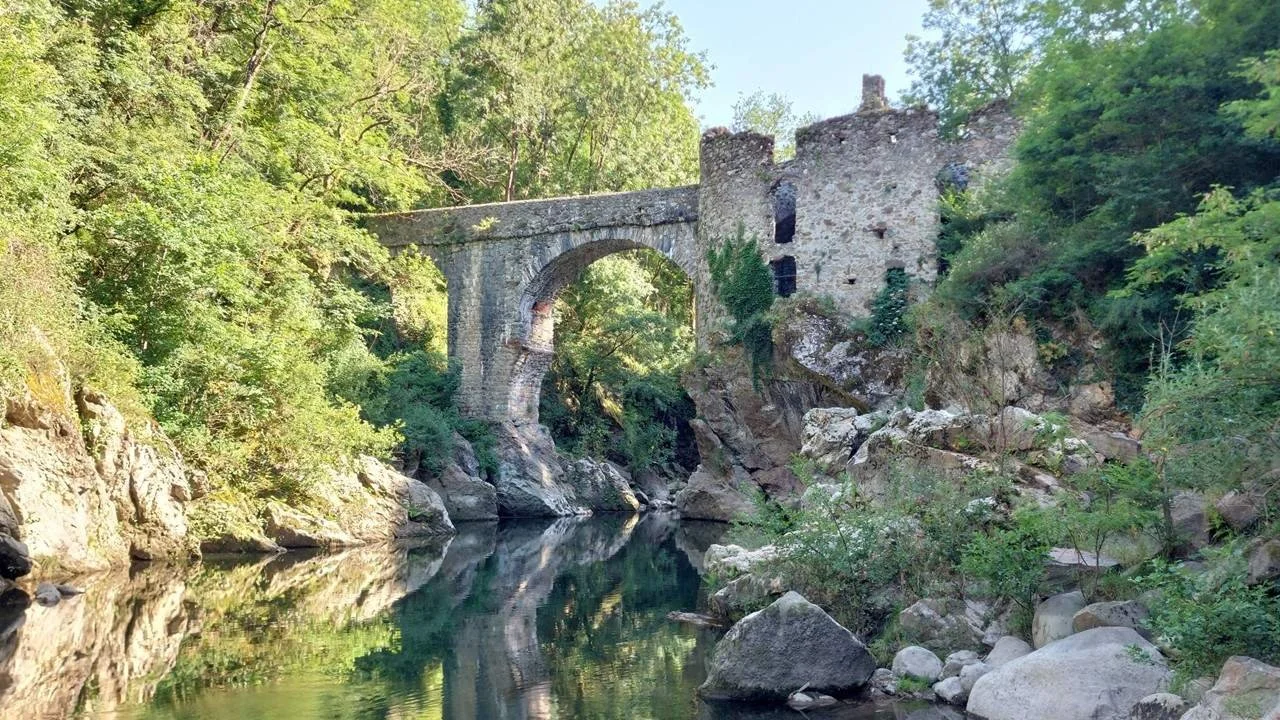
This Pont du Diable, or Devil’s Bridge, lies in the commune of Montoulieu between Foix and Tarascon-sur-Ariège.
There are dozens of Devil’s Bridges in Europe, and ten of them are located in the area I write about (see map below). According to legend, some were built by the Devil, while others were built by humans who had made a pact with Lucifer and sometimes succeeded in deceiving him. For example, the medieval bridge over the Tech at Céret has a single arch 45 metres wide. Surely such an ambitious span could only have been achieved with Satanic assistance?
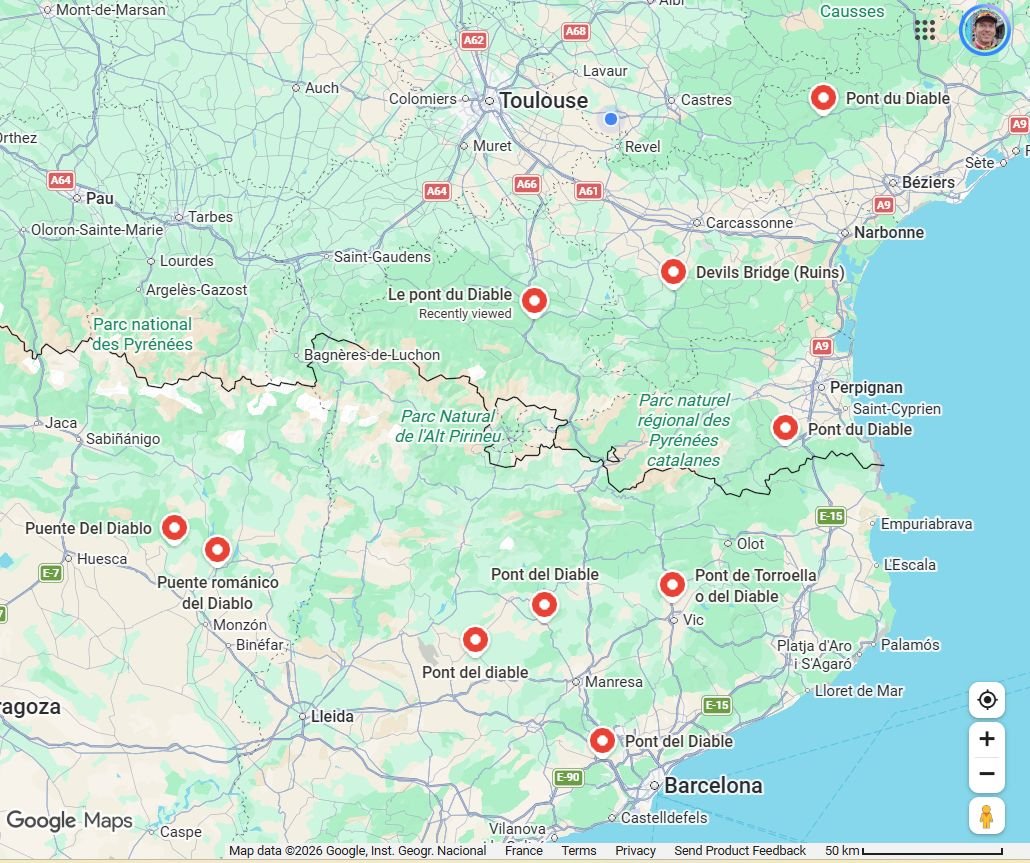
There are ten Devil’s Bridges in or around the Pyrenees.
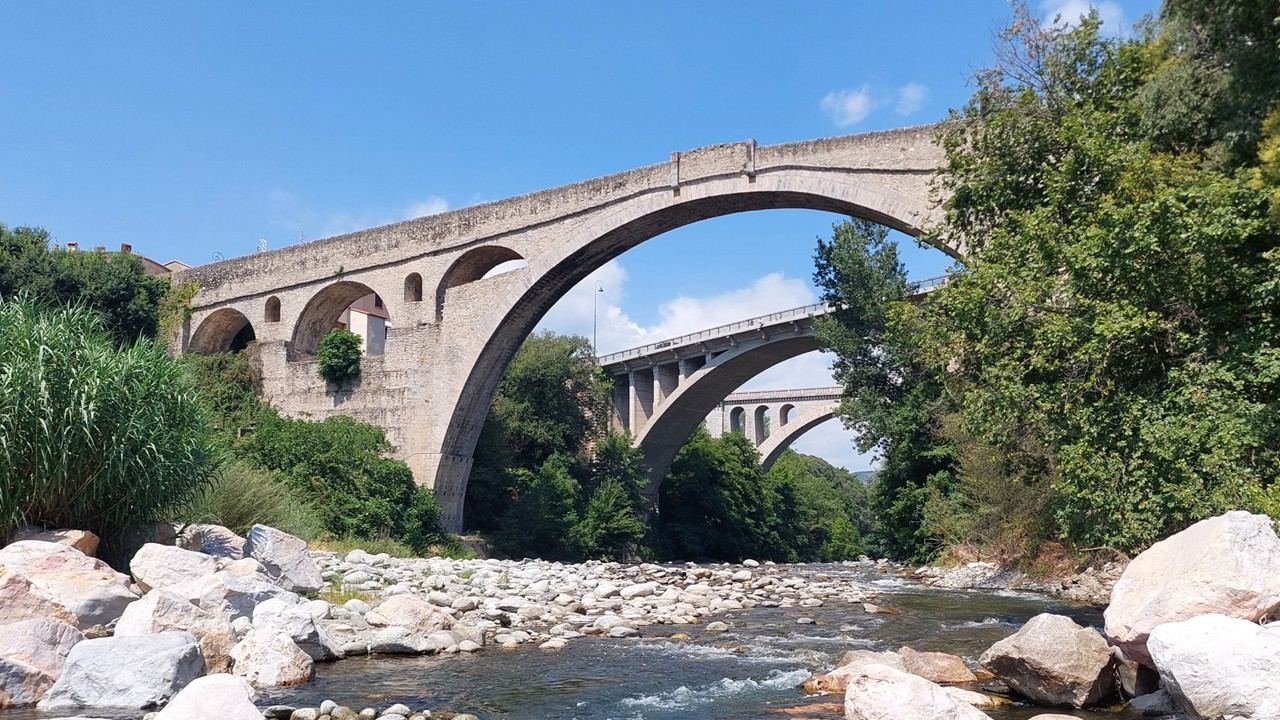
At Céret, there are three crossings of the Tech: Devil’s Bridge (nearest the camera), the road bridge and the railway bridge.
WHICH DEVIL’S BRIDGE HAS THE STRANGEST STORY?
The most curious origin story I have come across blends fact with fiction, and throws in a large helping of deception or perhaps misunderstanding. The bridge in question spans the Ariège between Foix and Tarascon in the French Pyrenees (see first picture).
In the early 13th century, the Count of Foix fought against Simon de Montfort and the Albigensian Crusade on many occasions (you can read more about him in my book ‘Lauragais: Steeped in History, Soaked in Blood’). Probably for military purposes, he ordered one of his vassals to build a new bridge across the Ariège within a month, otherwise he would be hanged. The poor Baron de Saint-Paul had no money to buy materials or employ workmen. As the month drew to an end, he turned to the Devil in desperation. The deal was this: the Devil would build the bridge in a single night in exchange for the soul of the first being who crossed the bridge at dawn.
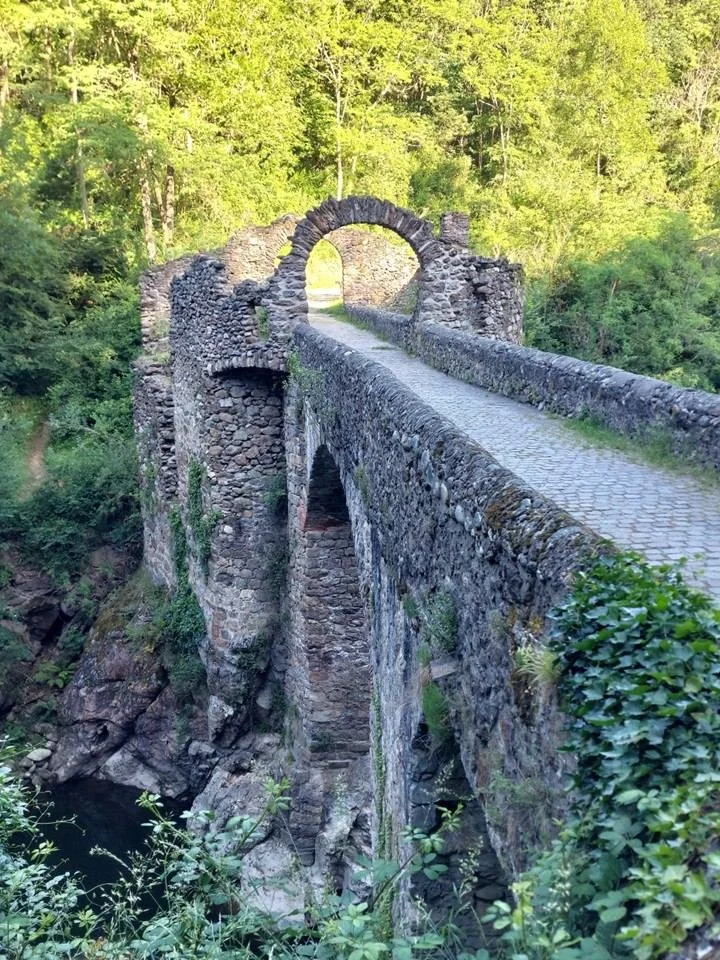
A paved road takes travellers over Devil’s Bridge.
PLAYING A TRICK ON THE DEVIL
The Baron had no intention of crossing the bridge himself, but he was filled with remorse at the prospect of sending an innocent soul to hell. He confessed his sin to the priest in Foix, but rather than scold him, the priest whispered a cunning plan in the baron’s ear.
The next morning, the bridge was ready. The Devil had kept his word and he waited patiently to claim his soul. When he caught sight of the Baron, he sniggered.
‘So, you’re to be the first, are you?’
‘Of course not,’ replied the Baron, and he set down a basket and opened the lid. ‘This chap will be the first to cross.’
And out jumped an enormous cat with a saucepan tied to its tail. Startled by the metallic din behind him, the cat fled across the bridge and disappeared. The Devil was so humiliated, he too disappeared, never to be seen again.
PLAYING A TRICK ON THE MINISTRY OF CULTURE
Even if this legend was implausible, the bridge was clearly ancient. In the 1940s, historians from the French Ministry of Culture came to study it. Their conclusion? It was probably built in the 13th century by the Count of Foix, but without the Devil’s help. In 1950 it was officially classified as a Monument Historique, and the government’s Monumentum website describes it as a medieval bridge with gothic arches and a fortified house at one end (visible on the right of the top picture).
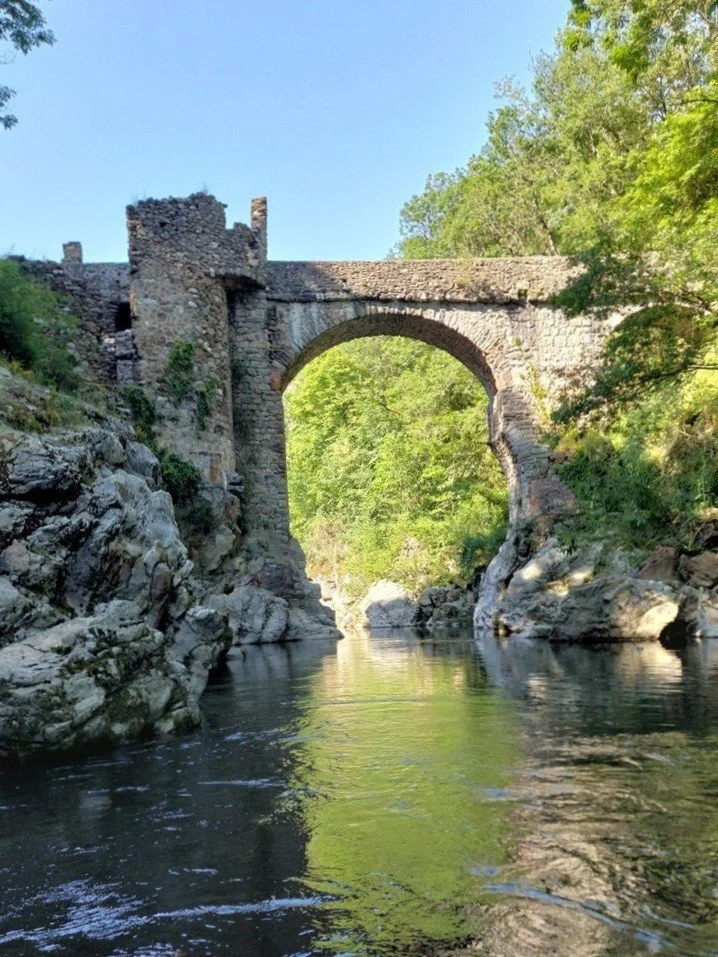
The historians should have delved more deeply into the bridge’s past. The Devil may not have featured in the true story, but the Devil was certainly in the detail.
In 2010, a local historian carried out more diligent research and came to a new conclusion. All the information boards and signage at the bridge have since been updated, but not the entry on the Ministry of Culture’s website.
AN INDUSTRIAL EXPERIMENT
The true story involves a man called Adolphe Garrigou. He was born in Tarascon-sur-Ariège in 1802, and he died there in 1893. During his long life, he became a successful industrialist, politician and the author of several books about Pyrenean history. In 1836, his brother-in-law showed him an intriguing plan. Léo Lamarque planned to build a flour mill on the right bank of the Ariège in the commune of Montoulieu, but he needed a bridge to reach it. He also wanted to use this bridge to test an innovative design of water wheel which could be raised or lowered from the central arch in response to fluctuations in the river’s water level.
Adolphe Garrigou provided the finance and the bridge was built without any help from the Devil. As for being classified a Monument Historique, perhaps some clever devil decided to play a trick on the French ministry of culture. Being classified as an historic monument gives a great boost to local tourism.
