The oldest Roman trophy
Many visitors to the Pyrenees will be dazzled by their natural beauty. Look more closely, and you will find astonishing signs of human activity. This is the second of three parts of an article that explores three exceptional locations.
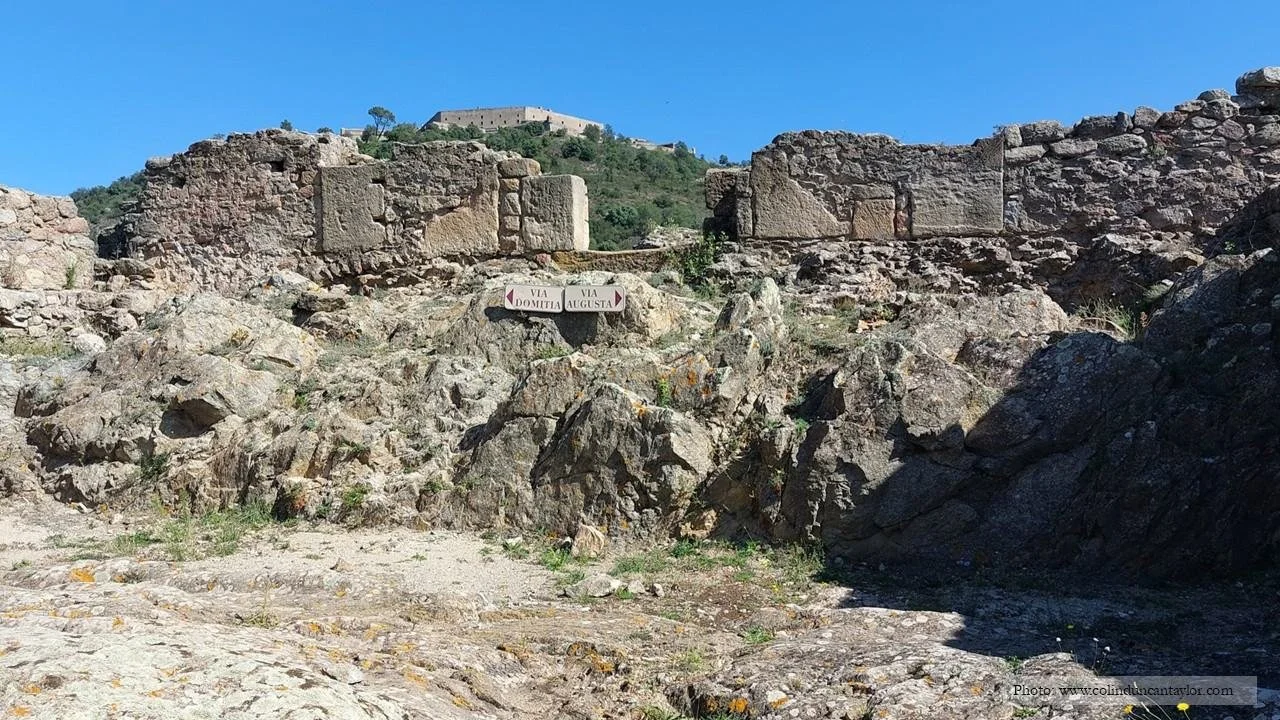
The remains of Pompey’s trophy, and on the hilltop behind, the 17th-century Fort de Bellegarde.
Around 71 BCE, the Roman general Pompey built a monument in the Pyrenees to celebrate 877 victories in south-western Europe. Called a trophy, this massive memorial was on the same scale as the Arc de Triomphe in Paris. It was built at the Col de Panissars, an ancient crossing point at the eastern end of the Pyrenees, and the Roman road passed within touching distance of Pompey’s grandiose monument. Visit the site today, and a couple of signposts pinned to the base of the trophy tell you exactly when you are stepping from the Via Domitia onto the Via Augusta, or from Gaul into Hispania.
The Romans often built their trophies on high ground where they would be visible from afar. The subliminal message to restless indigenous tribes was clear: remember how many times we have beaten you already! Only a handful of trophies survive. The ones built by Augustus in what is now Monaco and by Trajan in Romania are the best preserved, but Pompey’s in the Pyrenees is the oldest.

With the decline of the Roman Empire, Pompey’s trophy was pillaged for building materials. In the eleventh century, a priory was built over the remains, and then that too fell into ruin. As for the Col de Panissars, the Spanish side of the pass degraded to a bumpy dirt track, superseded by two modern roads a little further east. The site was ignored until the 1980s when a team from the University of Perpignan began archaeological excavations.
READ PART I (A FIVE-STAR INTERNATIONAL RAILWAY STATION)
READ PART III (THE MAIN SOURCE OF EUROPE’S TALCUM POWDER)
