Canfranc: a five-star international railway station
Many visitors to the Pyrenees will be dazzled by their natural beauty. Look more closely, and you will find astonishing signs of human activity. This is the first of three parts of an article that explores three exceptional locations.
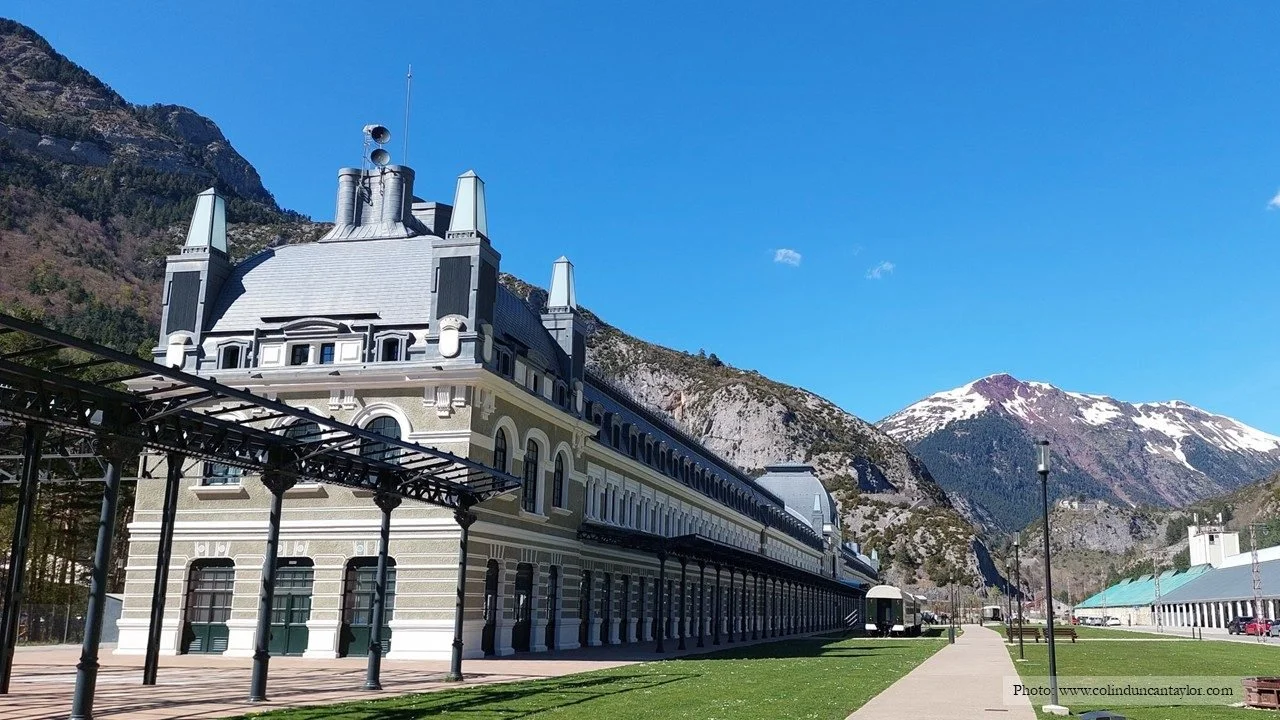
Canfranc reopened as a hotel in 2023. Spanish trains still come this far, but the service terminates in the new station building visible on the right of the picture.
In 1904, France and Spain began work on a project that would link Pau and Zaragoza by railway. Much of the route was already in service – the missing link was the section through the high Pyrenees. In 1908, work started on the Somport railway tunnel. Four years and 7,874 metres of tunnelling later, it was finished. But there was one more challenge to overcome. Although a matter of only 23 millimetres, it was of paramount importance. Spanish rails were 23 millimetres further apart than their French equivalents. Both passengers and freight would have to change carriage or wagon somewhere in the mountains, and that somewhere was Canfranc at the Spanish end of the new tunnel. As a result, Canfranc became a busy international railway station.
Opened in 1928, the main station building was grandiose in both its style and dimensions. With a length of 241 metres, there was space for a gleaming marble ticket hall, a hotel, a casino, a police station, a customs office and a post office. On the east side of the building, a vast goods area contained the infrastructure needed to handle the movement of freight from one gauge of railway line to another.
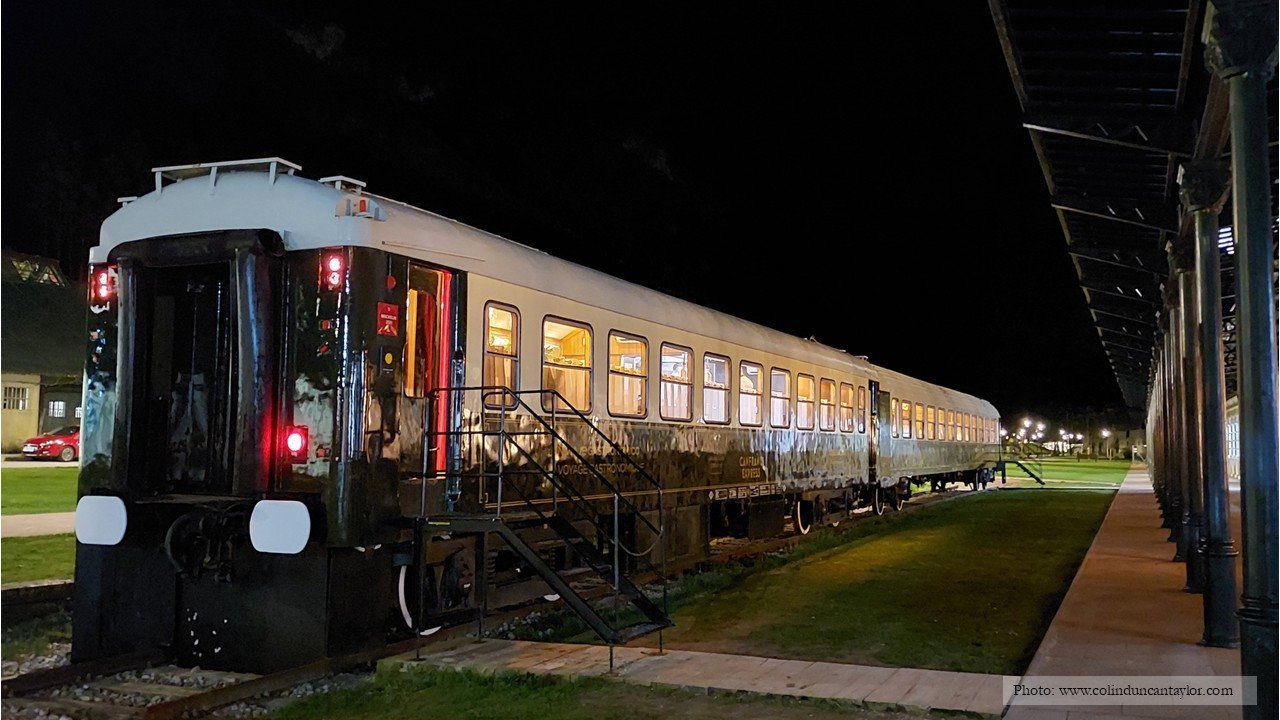
These carriages have been converted into a Michelin-starred restaurant.
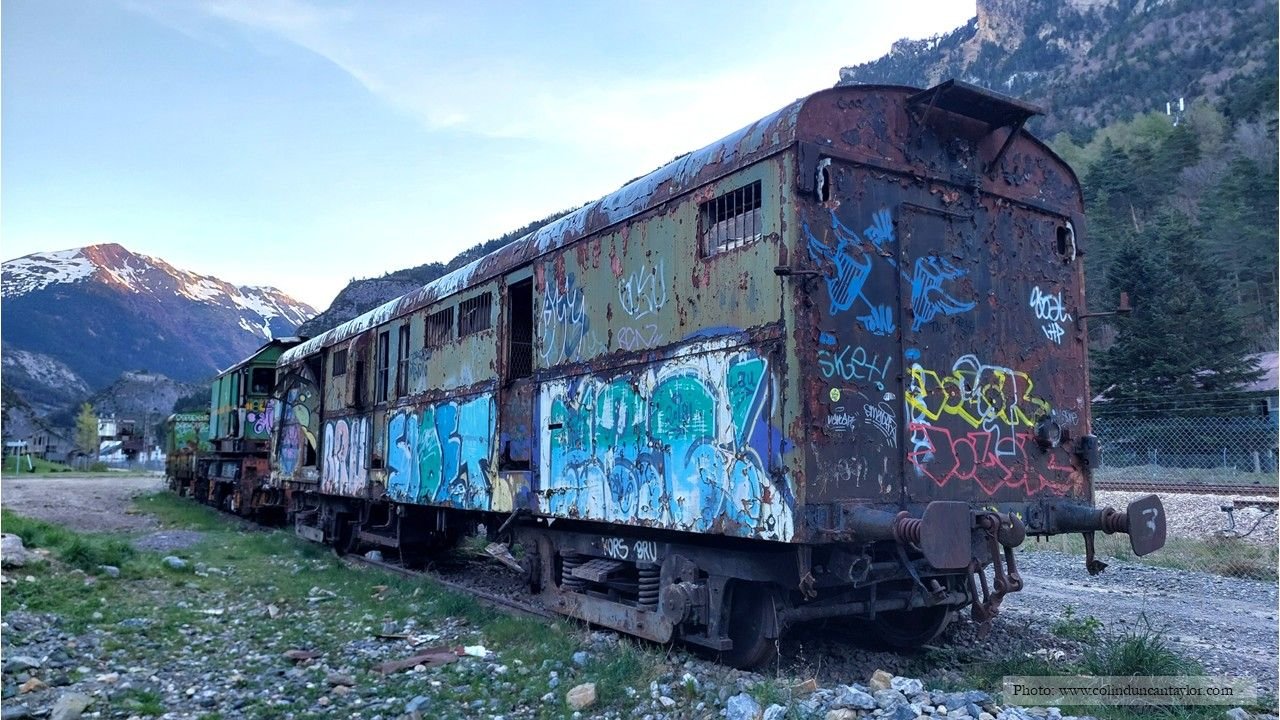
Other rolling stock rusts away in the cold mountain air.
Rail traffic declined steadily in the 1960s and then, in 1970, a runaway train destroyed a bridge on the French side of the mountains. The line never reopened and Canfranc fell into ruin. Fortunately, it was bought by the regional government in 2013, and ten years later the magnificent station building reopened as a 5-star hotel, including a Michelin-starred restaurant housed in a pair of refurbished railway carriages. Despite this renaissance, there are still plenty of reminders of Canfranc’s railway heritage, some of it restored, most of it quietly rusting away.
READ PART II (THE OLDEST ROMAN TROPHY)
READ PART III (THE MAIN SOURCE OF EUROPE’S TALCUM POWDER)
